
 Loading ...
BREAKING: Footage of US troops seizing Chinese-owned oil tanker off the coast of Venezuela
Ferrett
Lol Stay cool that’s for sure.
goldie 20:59, sums it up perfectly.
Too bloody hot at the moment for any revolting. Watzing Matilda? Who wants to sing a song about a loser committing suicide anyway? Maybe that’s why it’s the national song. Ah well, best get the Sheila to grab me another coldie from the fridge. Hey, Sheila ….
maddog,
i just crunched the gsr numbers, and got 64.68 toz ag to 1 toz au. does that match with your numbers?
France
Farmers taking their tractors to the source. No plans on letting these idiots turn their country into Zimbabwe or South Africa. They know to go after the cause.
Aussie satire
Quick videos
Buygold
Yes I get the point , but you can still make a better assessment if you know the valuations of what their mining and how much of it they get from each load of dirt on average and then compare that to earnings, PE et all and compared to the price of the stock for longer term than just news or on price sympathy. At times like this there’s also unknowns like buying or selling mines new findings with news and prices rising and increasing demand, speculators watching who will do options or buy and sell with it and different governments what they could be capable of doing to either the mines or the physical holders. Like China restricting exports and still buying from others, Mexico restricting mines from producing and cabal skimming off their profits for protection from them mainly, and Governments like Italy I heard they want the people to state how much gold they have so they can tax it. Might be another sneaky way to confiscate it. Tax it without spending it though??? Confiscation would be a risk. Just hope we don’t get a Democrat as president next election or ever again for that matter. When pms are expected to be much higher they’ll be going after the PMs from mines to stackers.
Goldie – just napkin math
I’m sure there’s going to be some other factors and that would depend on them producing the same amount of silver, but you get the point. These guys have to be smiling every time they ring the register.
Fund managers are supposed to be smart and forward thinking. Sure doesn’t seem like a lot of the smart ones are piling in. I wonder if many outside the funds that focus on pm’s, commodities or natural resources are even nibbling around the edges yet? Most of these stocks have doubled or tripled already, I wonder when they’ll take notice?
The one thing they’ll do when they jump in is they will drive prices far higher than they should be. It happens every time.
Indians ” some” are scanning your cards at stores they own
Foreign rip off fatigue. I minute videos.
Ipso
Washington is getting a serious pressure wash. It wants it’s rainbows back from the cross walks. This is crazy, never seen anything like this for Washington and Oregon. Those quick videos.
Buygold
I did a little more foot work back tracking.
New Found Gold Corp (NFGC) did not sell a mine or a major asset recently; rather, the company was acquired by another entity’s assets through a plan of arrangement. In a related but separate transaction, Dundee Corporation, a major shareholder, sold off a majority of its stake in New Found Gold.
New Found Gold’s Acquisitions
New Found Gold recently completed a plan of arrangement to acquire Maritime Resources Corp., which closed on November 13, 2025. This strategic combination was an acquisition by New Found Gold, not a sale of its own core assets. The acquisition included key gold projects and infrastructure:
- The Hammerdown gold project, which is targeted to reach full production in early 2026.
- The fully permitted Pine Cove mill and the Nugget Pond Hydrometallurgical Gold Plant, which provide processing facilities for both Hammerdown and New Found Gold’s flagship Queensway project.
New Found Gold also entered into a separate agreement in September 2025 to acquire additional mineral claims from Exploits Discovery Corp. to expand its Queensway Gold Project.
Shareholder Activity
In December 2025, one of New Found Gold’s major shareholders, Dundee Corporation, announced and subsequently closed the sale of a significant portion of its shares in the company. Dundee sold 24.48 million units of New Found Gold, reducing its ownership stake from approximately 10.8% to 3.6% on an undiluted basis. This was a divestiture by a major investor, not a sale by New Found Gold itself.
https://longbridge.com/en/news/268954544#:~:text\u003dDundee%20Corporation%20announced%20the%20sale,above%2010%25%20in%20the%20future.",null,null,"68",null,[124,null,null,null,null,null,null,null,1],null,0,null,null,0,null,0,null,[null,null,null,null,null,null,null,null,null,null,null,null,null,null,null,null,null,"https://longbridge.com/en/news/268954544",null,null,null,null,[null,null,null,null,null,null,[null,null,null,"/search/about-this-result?origin\u003dwww.google.com\u0026req\u003dCihodHRwczovL2xvbmdicmlkZ2UuY29tL2VuL25ld3MvMjY4OTU0NTQ0EjMKJwoCCHEKIQhdYh0KDGNvdW50cnlfbmFtZRINVW5pdGVkIFN0YXRlcxIECgIIRxoCCAAaACICEAFIAFgAaAA\u0026hl\u003den-US\u0026gl\u003dUS"],"https://www.google.com"],null,null,null,null,null,null,null,null,["Dundee Corporation Sells Majority of Stake in New Found Gold","Dundee Corporation Sells Majority of Stake in New Found Gold. ... I'm PortAI, I can summarize articles. Dundee Corporation announced the sale of a significant port","Longbridge","https://encrypted-tbn0.gstatic.com/faviconV2?url\u003dhttps://longbridge.com\u0026client\u003dAIM\u0026size\u003d128\u0026type\u003dFAVICON\u0026fallback_opts\u003dTYPE,SIZE,URL"],[null,1,[null,null,5,null,"Dundee Corporation Sells Majority of Stake in New Found Gold",null,"https://longbridge.com/en/news/268954544"],null,null,null,null,["https://longbridge.com/en/news/268954544",null,null,null,38,"Source: Longbridge"],2,null,null,["MAGI_FEATURE",null,"BLUR",0,0,0,null,"https://longbridge.com/en/news/268954544"]]],0,null,null,null,null,null,null,0,null,null,null,null,null,null,null,null,"Dec 8, 2025",0]]" data-hveid="CAgQAQ">
Dec 8, 2025 — Dundee Corporation Sells Majority of Stake in New Found Gold. … I’m PortAI, I can summarize articles. Dundee Corporation announced the sale of a si…
Longbridge
https://www.linkedin.com/posts/newfound-gold-corp_nfg-nfgc-newfoundlandlabrador-activity-7394736828844695552-run2#:~:text\u003d1mo-,New%20Found%20Gold%20and%20Maritime%20Resources%20Announce%20Closing%20of%20Previously,1mo",null,null,"94",null,[129,null,null,null,null,null,null,null,1],["https://encrypted-tbn2.gstatic.com/images?q\u003dtbn:ANd9GcTiXWX4G1WtFPSGvdPH_HYeHmWZMvI0X6dgGzaTI1kEGR_ZWHUB","",[null,2],null,null,225,225,"AWKKhK0H"],0,null,null,0,null,0,null,[null,null,null,null,null,null,null,null,null,null,null,null,null,null,null,null,null,"https://www.linkedin.com/posts/newfound-gold-corp_nfg-nfgc-newfoundlandlabrador-activity-7394736828844695552-run2",null,null,null,null,[null,null,null,null,null,null,[null,null,null,"/search/about-this-result?origin\u003dwww.google.com\u0026req\u003dCnFodHRwczovL3d3dy5saW5rZWRpbi5jb20vcG9zdHMvbmV3Zm91bmQtZ29sZC1jb3JwX25mZy1uZmdjLW5ld2ZvdW5kbGFuZGxhYnJhZG9yLWFjdGl2aXR5LTczOTQ3MzY4Mjg4NDQ2OTU1NTItcnVuMhIzCicKAghxCiEIXWIdCgxjb3VudHJ5X25hbWUSDVVuaXRlZCBTdGF0ZXMSBAoCCEcaAggAGgAiAhABSABYAGgA\u0026hl\u003den-US\u0026gl\u003dUS"],"https://www.google.com"],null,null,null,null,null,null,null,null,["New Found Gold and Maritime Resources Complete Arrangement","New Found Gold and Maritime Resources Announce Closing of Previously Announced Arrangement: Creation of an Emerging Canadian Gold Producer New Found Gold has compl","LinkedIn","https://encrypted-tbn2.gstatic.com/faviconV2?url\u003dhttps://www.linkedin.com\u0026client\u003dAIM\u0026size\u003d128\u0026type\u003dFAVICON\u0026fallback_opts\u003dTYPE,SIZE,URL"],[null,1,[null,null,5,null,"New Found Gold and Maritime Resources Complete Arrangement",null,"https://www.linkedin.com/posts/newfound-gold-corp_nfg-nfgc-newfoundlandlabrador-activity-7394736828844695552-run2"],null,null,null,null,["https://www.linkedin.com/posts/newfound-gold-corp_nfg-nfgc-newfoundlandlabrador-activity-7394736828844695552-run2",null,null,null,38,"Source: LinkedIn"],2,null,null,["MAGI_FEATURE",null,"BLUR",0,0,0,null,"https://www.linkedin.com/posts/newfound-gold-corp_nfg-nfgc-newfoundlandlabrador-activity-7394736828844695552-run2"]]],0,null,null,null,null,null,null,0,null,null,null,null,null,null,null,null,"Nov 13, 2025",0]]" data-hveid="CAgQBA">
Buygold 9:34
That is good you know how to do the math with what they are producing and what the stocks should be worth. With enough on my plate all the time I never found the extra energy to figure it out. Not the math but putting it together. Just a general scan that they’re prices should be higher now but like you said they’re trading at levels when the prices were lower. So what’s the reason if they are producing.. You may have hit on something.
Maybe they could find buyers at these prices for mimes they want to sell too. Like the stock you were wondering why it jumped up? They sold something. Should of saved it for you but they sold it I think around the 11 th don’t quote me I only did a quick scan as no other real recent news on it I could get so why would it spike now.
Digital ID’s …
… are dead on arrival in the UK … home of the commies themselves …
These data bases would be juicy targets for data/identity thieves that would put the gov’t on the hook for untold damages … and would add a level of vulnerability to bureaucratic theft already running off the scale.
This is an extinction risk to all governments taking part in this psyop.
Have a nice day.
Merry Christmas everybloody
Deer79 – thanks
I looked around at the silver share complex and a number of the shares popped higher in the AH’s.
Probably just some shorts covering not wanting to hold over the weekend.
Interesting stuff from Sprott.
ipso facto @ 13:04
Glad you posted that … I was getting to it … because it’s so important … marking (the milestone) the end of the EU experiment.
Now … their insolvency being exposed is unstoppable no matter what they do … where the entire EU parasitic superstructure sucking the life out of European states should be history within just a few years … ironically about the time this evil alliance is planning to be running the world with their digital centralization scheme.
What’s more … and parenthetically then … this should also torpedo their digital control plans as well … where decentralization forces increasingly gripping global macro conditions will continue to accelerate as the vulgarities, corruption, and unworkable outcomes associated with globalism (centralization) are rejected on mass.
It’s a matter of survival … where people are about to be forced to reject the lies and fairytales of the bureaucrats, bankers, and billionaires … or die.
You can’t eat bullsh*t … well you can … but it tastes like crap.
Chuckle
Buygold
I don’t think this has anything specific to do with NFGC, but Eric Sprott came out with his end of the year video/interview. He reviews the year, and claims that this is only the beginning of great things to come for the metals. He talks about the significance of the new Samsung battery and how it’s a game changer for Silver……
He also said that by the end of 2026, he would like his total exposure of Silver to Gold ( which is at 50-50), to go to 70-30 in Silver’s favor.
He currently owns 19% of NFGC……
Goldie
I did some napkin math on First Majestic – AG
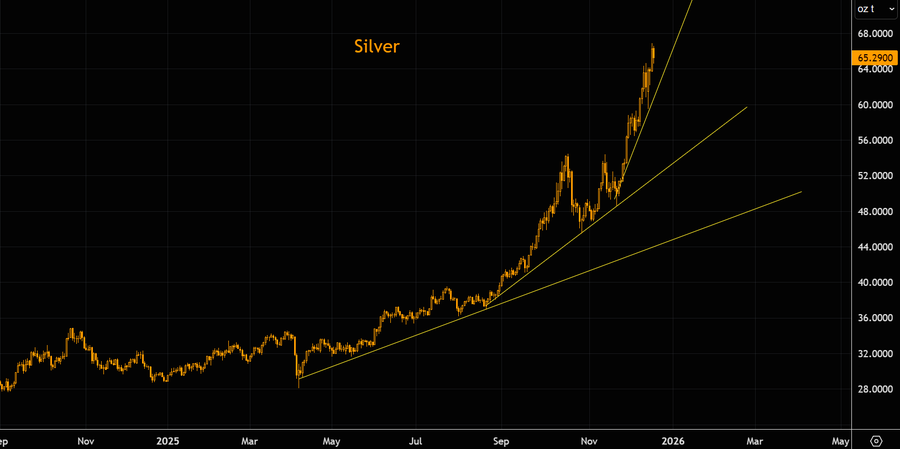
In Q3 they produced 4 million oz. of silver that sold at $39.03 on average. They earned $.13 a share. Using an avg. sales price of $54 per share in Q4, they will earn an additional $.44 per share. Estimates should probably be between $.50-.60 per share for the quarter. Multiply x 4 quarters and we’re talking $2 – 2.40 a share – that’s with silver at $54, not the current $67.
This doesn’t include the 753K oz. of silver and 4K oz. of gold they have in inventory that jumped from $51 million to $69 million in value.
Even at the low end of $2 per share they are trading at a PE under 9. At $2.40 a share they are a 7 PE. This with gold currently $13 an oz. higher than I factored in. IMHO, AG could easily be a $50 stock right now, but they are trading it as though silver is going to come back to the $40 range.
I sort of use AG as a proxy, just because I’ve followed it for so long. I’m sure the numbers are similar in many of these silver miners.
The silver shares are way undervalued compared to the gold miners, which are also undervalued.
I don’t know what a company like NEM is doing with all their earnings, but they sure aren’t paying a dividend anywhere close to what they should be. To me, this says there are going to be a bunch of buyouts, mergers, takeovers in the next 18 months if the metals stay strong. These things are becoming cash cows.
Any company that produces and can’t make money at these prices needs to be taken out and shot.
Buygold re. NFGC
I checked both the company’s web site and my Trading View platform, and don’t see any recent news ( last news disseminated on Dec. 11 regarding infill drilling).
Buygold
I wonder how many mines financed pre payments and contracts on future sales at a set price that did not expect current prices and demand. If that could have something to do with no or little change on earnings and stock prices.
Captain Hook
Re These guys must have deep pockets and no respect for risk (because they are using other people’s money
Yep And got bail outs too.
Donkeys years ago I checked out gold shares,
and when they took off when gold was shooting up. Probably the 1980 spike. There was a lag of 9 months or so before the shares reacted, and the reaction was quite violent. and they all went, producers, explorers the lot. Anything with ‘gold’ in the name including a couple of companies with nothing to do with gold!