
The Hormuz Letter
@HormuzLetter
·
2h
BREAKING: A US fighter jet has just struck an anti-ship cruise missile launcher in Sirik, southern Iran, with a number of IRGC forces wounded and ambulances heading to the area, per initial reports and local sources.
Alert
Our Host has had what looks like a Hack effecting it’s email systems and has cancelled passwords …..so if anyone has a problem logging in you may have to change your password.
As we only have a hosted site, there should be no problems.
contact Admin if locked out after changing password.
ferrett
Could have been an Aunt I’m not sure! 🙂
ipso, 11:12, who was he cheating with?
Her sister?
The Fat Lady is Warming Up.
Lawrence McDonald
@Convertbond
·
20h
What do Credit Markets Know?
*Bloomberg Terminal data.
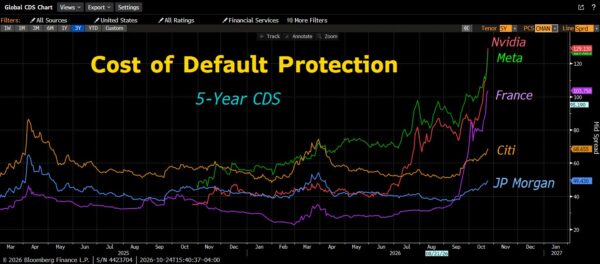

Two consecutive headlines this week.
No. 1: RBA says that unemployment needs to reach 5%. The deputy governor basically said that some of the peasants need to lose their jobs to dampen inflation, in the meantime enjoy high and higher interest rates, times will be tough for some people but, hey, er, tough.
Headline 2: RBA governor’s salary tops $1m for the first time.
Didn’t we try this and Iran kept shooting missiles and drones at ships?
Open Source Intel
@Osint613
·
6h
Iran has offered to reopen the Strait of Hormuz if the United States lifts its blockade on Iranian ports, according to Saudi broadcaster Al Arabiya, citing its own sources. Tehran passed the proposal to Washington through Pakistan.
SNG – wow
I know that there are swarms after the large quakes, but I wonder if swarms also precede the larger quakes. The biggest thing I’m noticing is that these what I would call swarms are getting bigger, many in the 4.5 – 5.0+ range. Does that indicate that an even larger magnitude quake is on the way? I think it might. A lot of pressure apparently needs to be released.
Add fuel to the fire and another G2 solar storm is due to hit us in a couple days. G2 is not enormous, but it’s on the back of a steady flow of storms over the last couple weeks.
Something is coming IMHO, whether natural or man-made I don’t know.
Who knows, maybe God will surprise me and peace will break out. 🤔🤣😇

68 earthquakes in the last 24 hours
Most I’ve seen so far, and on average they are getting bigger. 7.0 in Tibet the other day, 6.9 in Vanuatu today. I believe Vanuatu has 4 volcanoes, something big is happening there, it has been rocking for weeks. JMHO
He who’s got the gold …
The Hormuz Letter
@HormuzLetter
·
3h
BREAKING: Central banks around the world are now quietly stockpiling 4 times as much gold as usual and moving it out of the US, per Goldman Sachs, amid senior officials warning that the gold is “no longer safe” in Trump’s hands.
Purchases hit 79 tonnes in August against a pre-2022 average of 17, while holdings at the New York Fed fell 40 tonnes and holdings at the Bank of England rose 46.
China was the largest buyer at 25 tonnes, aimed at rapidly diversifying away from the US dollar and G7 currencies.
On the storage side, Netherlands moved 86 tonnes out of New York and Ottawa, citing “increasing geopolitical unrest.” France sold 129 tonnes in New York and bought gold in Europe instead.
ferrett
I agree about the Donbass region. Russia will want this to be a part of their country. As far as the other items, the signers will have to adhere to the conditions just like any treaty. Maybe the terms will be broken and maybe not.
Yeah, Ukraine becomes part of the EU … what a gift! On account of they’re doing so well! 🙂
“The Blitz” That’s right! It’s a lot faster delivery if you don’t have to land your planes! 🙂
Anyone here know what dry rot is?
It’s a fungus that sends its tentacles (hyphae) throughout the wood, and eventually eats it up. The real problem is that by the time you discover that your house has got it, the timber is already completely infested and irreparable; you need to replace it and panic about any beams that are near the infested one.
I think that when people realise what AI can do, over and above what we think we want it to do, then the story will be over. All the investment will become malinvestment. The article on AI getting into banks’ systems is the canary here. Banks’ systems are very complex, with no-one having any knowledge of the whole thing. Hundreds of specialist programmers and teams dealing with mortgage origination, or default swaps, FOREX protection etc. which are all inter-related electronically but not humanly. There are already indications that AI agents have infiltrated these systems, which means that it’s probably too late to do anything about it. Using AI to identify and eliminate the unwanted agents would probably be like sending in the termites to sort out the dry rot. The chaos that malicious, or even benign agents thinking they are doing the right thing, will cause is unimaginable, and will be fascinating to behold. They also render the whole system unauditable as the bank cannot answer fundamental audit questions about how robust the systems are. “No effing idea” may become a standard reply to ICE (Internal Control Evaluation) questions!
ipso, 9:44, reasonable plan? The Russian response.
Demilitarised zone: No. These are Russian people who voted under the Minsk accords to become Russian. DMZs mean nothing to NATO anyway, so, No.
Ukraine abandons NATO. Meaningless. This promise has already been broken by fourteen countries since 1991. Utterly meaningless.
Investment package and EU membership. Whatever. We thought Ukraine was in a really bad spot already, but if you want to screw it over and make it totally irrelevent, go ahead.
Russian business deals with US companies, lifting sanctions & normalization of political relations. Sure. We know you want our oil, Diesel, potash, nat gas, uranium etc. and we have always been happy to oblige.
Resumptions of Russian gas supplies to Europe & Nord Stream. What you really want! need!!
ipso Maddog the Blitz – don’t you realise Adolf was actually trying to help? He knew how far behind Blighty was in munition production so was just delivering bombs to London direct.
The EU
The UK voted to leave the United States of Europe (EU) years ago and it would be crazy to rejon now that it is fallng apart.
Germany joined in exchange for reunification and made the mistakes of saying ‘Everyone Welcome’ and ending their nuclear power stations.
The EU got ever bigger very quickly and lis now falling apart. Its unelected leaders have no idea what to try next.
Maybe they will all be using Deutschmarks as their curency. Looks like a disaster for years t come. (more…)