RIGHT ON TIME !!
(do i hear forty one ??)

RIGHT ON TIME !!
(do i hear forty one ??)
Vaccines Hep B they could only get if their mother has it. Baby’s dying for nothing but big pharma profit
Logical feelings. Next target they will be watching for 45.
Not sure how it will play out given the markets are closed here tomorrow.
Hopefully it’s not a spike followed by a reversal tonight or tomorrow night, when the US markets open again, that would mark some kind of short term high.
We’ve seen that movie before.
I think their hiding the numbers. I think it’s a lot more than that.
Libs of TikTok
@libsoftiktok
·
22h
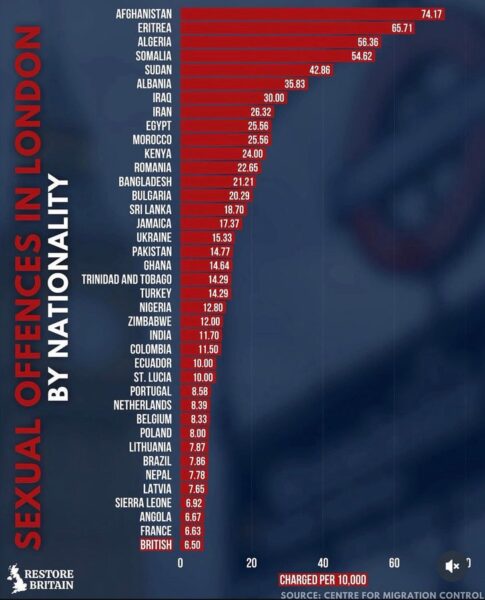
S*x offenses in London by nationality
This should tell you everything you need to know…
I can tend to have a unusual sense of humor.
Mean while make a hostile environment to have or raise children for citizens.
A rather idealistic England to be sure, bucolic, beer, strawberries and cream; unchanging. And the hobbits are obviously the English, not liking change (or adventures!), mild, sociable, insular but subject to being roused. The penultimate chapter, “The Scouring of the Shire” was considered by Tolkien to be the most important chapter of the book. In it, the hobbits finally rise up against a tyranny that was gradually imposed by foreigners infiltrating the country under Saruman’s guidance. The Shire has been made ugly, violence against the original inhabitants rules the streets, traditional ways are demolished and rules, more rules and ever more rules are forced upon the hobbits but not the invaders.
It was never filmed. If it had been, snippets would today be continually being played on youtube, instagram etc. with many GIFs and memes, and those playing it would be deemed insurrectionists, fascists, racists etc.
Whoa! This is about privacy and money. Bitcoin isn’t anonymous. Many folks think it is though—seriously? People see a public ledger and assume privacy by obscurity, and that assumption is dangerous because it glosses over how chain analysis firms tie addresses together and follow value across hops.
Here’s the thing. CoinJoin is not magic. It’s a coordination technique that changes the heuristics analysts rely on, and when it’s done well it increases plausible deniability for sane, everyday use-cases like payroll privacy, business bookkeeping separation, and keeping your tipping habits to yourself. Initially I thought CoinJoin would be an all-or-nothing privacy fix, but then I realized it’s more like insulating tape—useful in many places, but not a cure-all for every leak or metadata problem.
Okay, quick gut take—privacy is a social good. Hmm… yet it also frustrates regulators and some payment systems, which leads to a complicated legal landscape. On one hand you want your finances private; on the other hand there’s legitimate law enforcement interest in certain flows—though actually, wait—let me rephrase that: the balance is messy and context-dependent.

CoinJoin bundles many users’ inputs into one transaction so that linking a particular input to a particular output becomes much harder. That sentence sounds simple because it is simple in concept, but the implementation details and the threat model you carry matter a lot. For example, a passive chain observer who only sees on-chain data faces a different challenge than an adversary who can run a node, subpoena a coordinator, or compromise a participant’s privacy off-chain.
CoinJoin reduces certain heuristics. It erases some obvious patterns like change-address clustering that often gives away ownership links. But it doesn’t remove every fingerprint—timing, participation patterns, and reuse of outputs can leak information back to investigators or automated analysis tools. My instinct said “problem solved” at first, but reality nudged me back. There’s always some residual risk.
Wasabi takes a privacy-first approach to CoinJoin coordination. I recommend checking out wasabi if you’re curious about a widely used, open-source desktop wallet that emphasizes CoinJoin and network-level privacy through Tor. I’m biased, but I’ve followed its development and seen how the project negotiates usability, cryptography, and user trust—it’s not perfect, but it’s substantive.
Now let’s talk trade-offs. CoinJoin requires coordination and fees. It demands patience because you wait for matching rounds. That’s a user experience cost. There’s also a reputational cost in some circles—some custodians and exchanges flag or delay funds that look “mixed”. That’s real, and if you’re using CoinJoin for legitimate privacy you still may encounter friction at onboarding points, and that’s frustrating and very real.
Another important point: mixing doesn’t hide who you are at the edges. If you post an address publicly or log into a service that ties your identity to coins, no amount of on-chain obfuscation undoes that link. So consider your whole flow—how coins are received, stored, and spent—because privacy is cumulative and leaky in many small ways.
From a threat model view you must ask: who are you hiding from? Casual blockchain snooping? Then CoinJoin helps a lot. Targeted state actors with subpoenas or long-term transaction linking? Then CoinJoin may help but won’t be bulletproof unless you combine it with strict operational security. Initially I thought better tools would be enough, but then common sense and some cautionary tales made me tighten that view.
There are also systemic effects worth noting. When more people use mixing schemes responsibly, the anonymity set grows and everyone’s privacy improves. That’s the positive feedback loop. But if usage is sparse or heavily concentrated in obvious clusters, the protections weaken because analysts can single out atypical participants. So adoption patterns matter—sociology and math collide in interesting ways.
Ethics and law intersect here too. I’m not a lawyer. I’m biased toward privacy as a human right, but laws in the US and elsewhere interpret “mixing” differently depending on context. Some services faced enforcement based on suspected misuse by third parties. That history should temper your assumptions; privacy tools can trigger scrutiny even when your intent is clean. I’m not 100% sure how every jurisdiction will treat mixed funds tomorrow—regulatory environments shift fast.
So what operational guidance is safe to share in a public article? High-level stuff only: understand your threat model, avoid reusing addresses, separate personal from business flows when possible, and pay attention to on-chain metadata like memo fields or public posts. Do not assume CoinJoin grants immunity. Don’t use privacy tools to facilitate wrongdoing. Simple, right? But people trip over the nuance all the time.
One thing that bugs me is how polarized the debate gets—some say “privacy or bust,” others dismiss CoinJoin as futile. Both extremes miss the middle: practical, layered privacy that accepts trade-offs and evolves over time. It’s about making it harder and more expensive to trace routine transactions, not about guaranteeing zero-trace outcomes in perpetuity.
Technically, there are different flavors of CoinJoin and mixing—decentralized protocols, custodial mixers, and semi-cooperative coordinators each bring different trust and attack surfaces. I won’t walk through procedural steps here, but know that trust assumptions change with architecture. Some designs minimize trust by cryptographic means; others require you to trust a coordinator or custodian. Weigh those trade-offs against your needs.
Practically speaking, if you’re privacy-minded in the US, consider where you hold accounts, how exchanges classify mixed funds, and what your local financial reporting obligations might be. Also, use good endpoint hygiene: a compromised device undermines many privacy gains. I keep a separate environment for large-value privacy operations—call it paranoid, maybe—but that extra care has saved me headaches.
No. Using privacy-enhancing techniques is generally legal in many places, including the US, but context matters. Attempting to evade sanctions, launder proceeds, or assist criminal activity can be illegal, and providers or users may face scrutiny if funds are tied to illicit behavior. Be cautious, and if needed consult a lawyer for high-risk situations.
No. CoinJoin increases privacy by reducing linkability, but it does not guarantee perfect anonymity. Combining CoinJoin with careful operational security, network privacy (like Tor), and thoughtful address management yields better results, but nothing is foolproof.
Wasabi is a respected option if you want desktop CoinJoin coordination and a privacy-focused interface. It’s worth researching and testing with small amounts to learn the UX, costs, and behaviors before committing more funds.
I think you mean peasants. But pheasants is funnier!
Finally had enough. A fist is stronger than a single finger. About time. They’re coming in illegally pheasants needing to be housed but thinking they can make their own rules.
That would be a problem. The government wasn’t sure what they were doing how can the business and postal service make any plans.
The head of the Australia Post was quite candid about it. They had no idea what, or when, anything would actually happen. So they couldn’t prepare for it. Now that they have something concrete to work with, shipments are delayed until procedures are put in place to collect and remit the tariffs. I understand what Trump is trying to do, but it’s been done in such an unbelievably hamfisted way that I don’t believe there was any actual plan, just expected outcomes.
Don’t wait too long to get reimbursed.
Multi country’s stopping postal service to the US.
I haven’t watched it yet. Trying to manage to balance all the negatives with positives. But.. does it have to do with trading your independence and free will be to total control by ass hats with CBDCs, basic income, tiny housed and social credit scores. Lol
All these brainless scum harassing businesses during Covid and trying to find ways to fine them to get easy money off it when they’re already losing money and trying to survive resulting in non recoverable detriment. They can tell them their easy little tax dependent job just ran out of money because of it, their fired. Their cushy retirement pension they planed.l while they ruined it for others who worked for it. Forget about it.
That could wind up backfiring on them for QE. There’s so many people, more so young less experience even out of college that can’t find jobs and some that don’t pay the doubling housing that was totally unnecessarily based on morales greedy scumbags along with slumming delapadated apts for illegals for government money during Biden. Even restaurants aren’t hiring as much because so many closed because of COVID lockdowns.