
If fear knocks don’t answer, if doubt speaks hit the throttle.

Might not hear much about this song
But should go viral in the EU and UK with a two finder salute to their loser governments.
Balance of powder, digital and economy.
You are no longer a consumer, your compost lol
My phone going wacko yesterday. Pages moving around when trying to write, disapeaing and another page popping up.A little better today
If you didn’t see the Affordable Housing Act scam they slipped digital CBDCs for central banks in that bill.
One man band
Creative
Song by Jim.Morrison, The Doors.
https://www.facebook.com/reel/1904057986950683/?mibextid=rS40aB7S9Ucbxw6v
Long Green
Oliver Groß
@minenergybiz
Gold Miners’ Earnings Season: The quarter after “Peak Margins” 💰⛏️
The eagerly anticipated earnings season in the gold mining sector will begin again in just a few days.
It is already certain that gold producers’ margins reached their preliminary high in the first quarter of 2026. The average gold price in the first quarter was approximately $4,900 per ounce. For the second quarter, the estimated selling price of gold from mines is around $4,400 per ounce.
However, even with a gold price of $4,000 and ongoing cost inflation and rising energy costs (assuming AISC of $2,000), most gold producers will continue to generate substantial profits and excellent AISC margins of $2k+/oz.
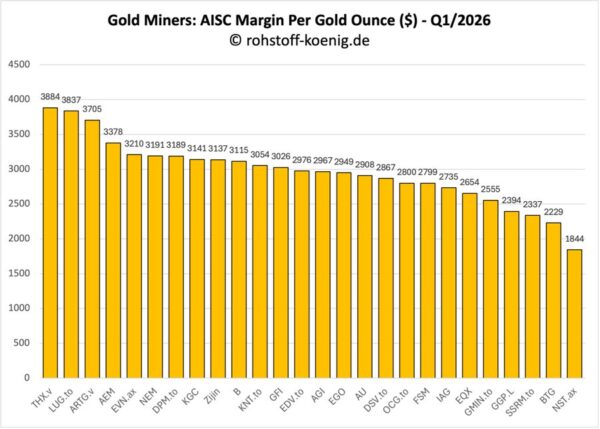
Now, let’s take a look at the AISC margin leaders in the gold mining sector for the first quarter of 2026. 🪙👇
Gold Miners: AISC/Profit Margin Leaders Q1/2026 ($/oz)
1. Thor Explorations: 3,884 👑
$THX.v
2. Lundin Gold: 3,837 👑
3. Artemis Gold: 3,705 👑
Katie from UK is hilarious
She gets arrested for saying something about herself.
Retail was up ?
What a coincidence, so were on sales everywhere.
When choosing a president
It’s just not the socialist agenda they have to look out for, but if there involved in things like real estate, big pharma, oil, with the exception of Ross Perot, a neocon, but someone more like Ron Paul.
This auto incorrect is something else
I’m so sick of hearing these over paid know it alls telling people what they can’t do or afford while sitting next to their cup of sfarbucks telling them they can’t affird it in order to hand over priced rent, don’t go anywhere except to work and ride a bike or take the bus so they can give the realtor scum cabal all their money and call this a free country.
These city kid demos in NY
Who want a government run grocery store think it’s easy as just opening a store at lower prices. They don’t seem to understand that it’s the farmers, shippers, butchers, packagers, canners,storage, then more shippees to the stores that need their cost down and opening up more land to farm not rental apartments.
There for open borders and governments paying more of their tax dollars that pay more for them than they can get from the citizens while causing shortages driving cost up along with tweaking the appraisal numbers. They think just freezing it is going to solve the problem instead of addressing the unconstitutional corruption they vote for on the left along with it thata behind it. They said the renters were getting 12 percent a year and they want more. When Fox asked them how much they should get they should of said head cut it in half. It used to be 6 percent then they doubled it. That it’s not only hurting the renters and buyers it’s hurting the rest of the economy because it’s no longer one week pay check they want all their pay checks so what do they tell them… Oh just don’t buy that latte or don’t buy this or that and eat cheap and unhealthy. Don’t by a car take the bus. Over priced housing doesn’t grow the economy it kills it.
Buygold
If everybody knew the exact bottom there would be a rush to buy. Then the MM would make them chase it and they’d lose money anyways by the end of the day temporarily anyways. Until then you can hedge.
Save Act
Senate filibustering and repubs don’t have enough seats to vote the Save Act requiring proof of citizenship to vote. I bet the filibuster was done strategically to stop the Save act. I can’t get information what it’s about or what there claim to stop other than the Save Act.
Buygold
Close but everything else market topping doesn’t help. Dow -400
More “painful accumulation”
Actually thought there was a chance today.
NYET! 🤨
Ipso
That would be a good place to start. $4k
I do wonder why Bessent felt compelled to state we had the gold.
Better day for sure, but really hard to trust. Still no real interest and no volume. Not sure I agree with Tavi on the “painful accumulation” with no volume.
Maddog
Glad to see you back. 🙂
Are the French still full of joie de vivre?
Gotta go do some chores
Buygold @ 12:07
Most of those charts are very long term. I think he’ll be right in that time scale … but for the short term it’s anyone’s guess.
A little better day today than yesterday. My bruises have bruises! 🙂
Are the central banks providing us this floor around $4000? That may be the case.
Ipso – Tavi
The problem for Tavi is he’s been saying that for a while now and he’s probably like me. Bought some shares in the last few weeks that appeared to be really cheap but have proceeded to drop another 30-40%.
He’s probably right though, the best possible outcome for us is that the SM craters and we catch a bid instead of leading it down.
Hope we’re seeing the beginning of that today. This has been rough.